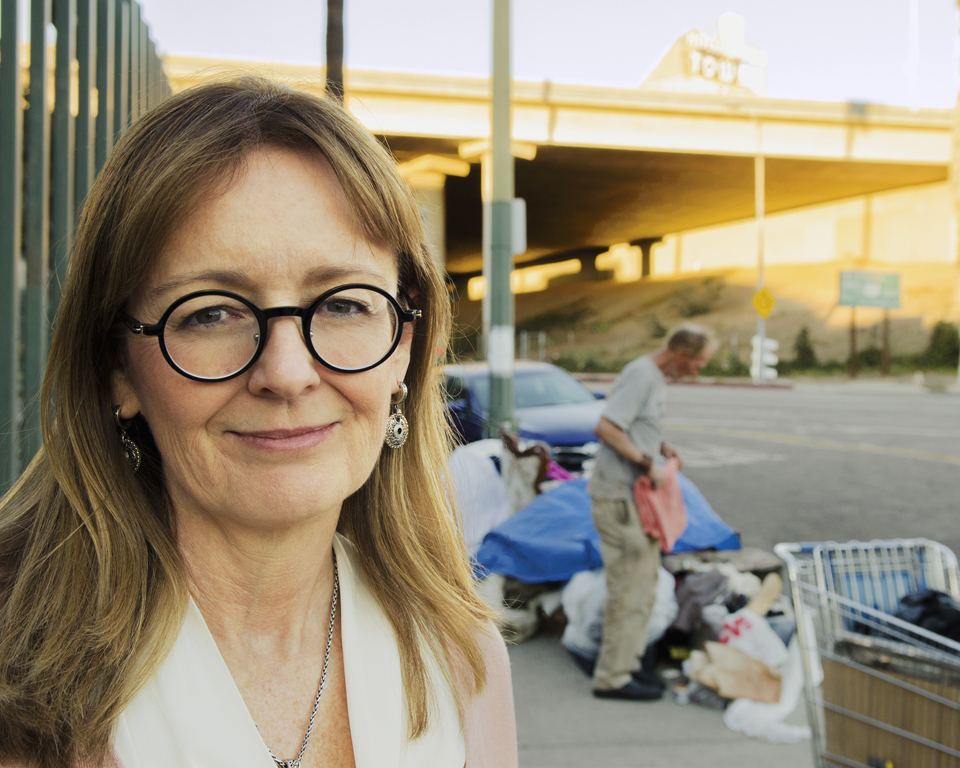
Helmi Hisserich is the former Assistant General Manager of the Los Angeles Housing Department (formerly the Housing and Community Investment Department of the City of Los Angeles). A former banker and Deputy Mayor who has worked in local government for decades, she has observed how multiple public agencies work on housing and homelessness but fail to effectively pool their knowledge to advance problem-solving. Helmi seeks to transform how city departments working on housing and homelessness communicate with one another, elected officials, the community, and other partners by creating a platform for open access to information.
* Helmi transitioned out of her role at the Los Angeles Housing Department in 2021.
Fellowship Summary
Mapping the Black Hole of Affordable Housing
A friend of mine is a radio astronomer who maps black holes. Twenty years ago, I asked him how he creates an image of something he cannot see. He told me to imagine standing at the edge of a lake looking at an object plunging up and down in the center.
“You can’t see the object,” he said, “but if you measure the lengths and the intervals of the waves at the shore, you can figure out what it looks like. The more points you measure from and the longer you collect the data, the clearer the image becomes.” I had this image in my mind when I started my Stanton Journey.
I always thought the work of affordable housing was less complicated than mapping black holes. But while radio astronomers have made revolutionary discoveries about the origins of the universe, those of us trying to solve the far less esoteric problem of urban housing are stuck. Our strategies haven’t changed much in 20 years, and our failure is apparent in the growing numbers of people living in overcrowded housing, parked cars, and tents on the sidewalk.
Even now, when the political will to end homelessness in Los Angeles seems stronger than ever before, I know without a doubt the $1.2 Billion “Measure HHH” housing bond won’t come close to addressing the need. Last year, there were 34,000 homeless people living on the streets of Los Angeles, and a million more residents in Los Angeles are barely keeping a roof over their heads. With vacancy rates in the low single digits, the poorest residents of Los Angeles regularly lose their foothold on housing, leading them into a downward spiral of homelessness and economic loss. We are not keeping up. Based on a recent study by McKinsey, Los Angeles needs to build 175,000 new affordable housing units by 2025. Optimistically, we will have enough to fund about 30,000.
So, I started my Stanton journey standing on the edge, peering into darkness, trying to see the shape of the problem. It made perfect sense to start my journey at the Santa Fe Institute, a think tank known as the world headquarters of complexity science. I took a course with Luís Bettencourt—a professor of complex systems and urban sustainability—who brought lecturers in from around the world who are using big data to uncover new ideas about urban areas. The theory is that cities, especially large ones, have evolutionary properties that derive from millions of people living side by side, interacting with each other, learning from one another. And like biological organisms, the dynamic networks within large urban areas create opportunities for rapid, scalable change.
It was there in Santa Fe that I realized the Los Angeles housing crisis could be solved, but we needed to change the way we were trying to solve it. We needed to harness the capacity of a complex system to evolve solutions. We could do this by harnessing the data of the city and making information available to people who could do something with it.
I set up a skunkworks project at a shared office in the Arts District, hired a bunch of students (got some of them for free), and began conducting focus groups around the concept of a virtual think tank located in the public library. I tapped into a vein of creative, youthful energy that is ever present in Los Angeles and somewhat missing from the government. We explored the types of housing information people wanted. We looked at sources of data and discussed how to organize it. We created a prototype website and a business plan for implementing a housing think tank in partnership with the library. I am looking for funding and support, and I have applied for a grant from the Haynes foundation.
So here are my three big discoveries. First, librarians! I discovered that students coming out of library school are extraordinary at organizing complex information. Second, the housing crisis is not a Los Angeles problem—it is a worldwide problem growing out of the massive worldwide shift toward urbanization. London, Moscow, Rio de Janeiro, and Guangzhou are all in the same boat. And third, I discovered that cities with powerful data and communication technologies will drive the social connections that create solutions to complex urban problems.
Why not us, why not now, why not Los Angeles?