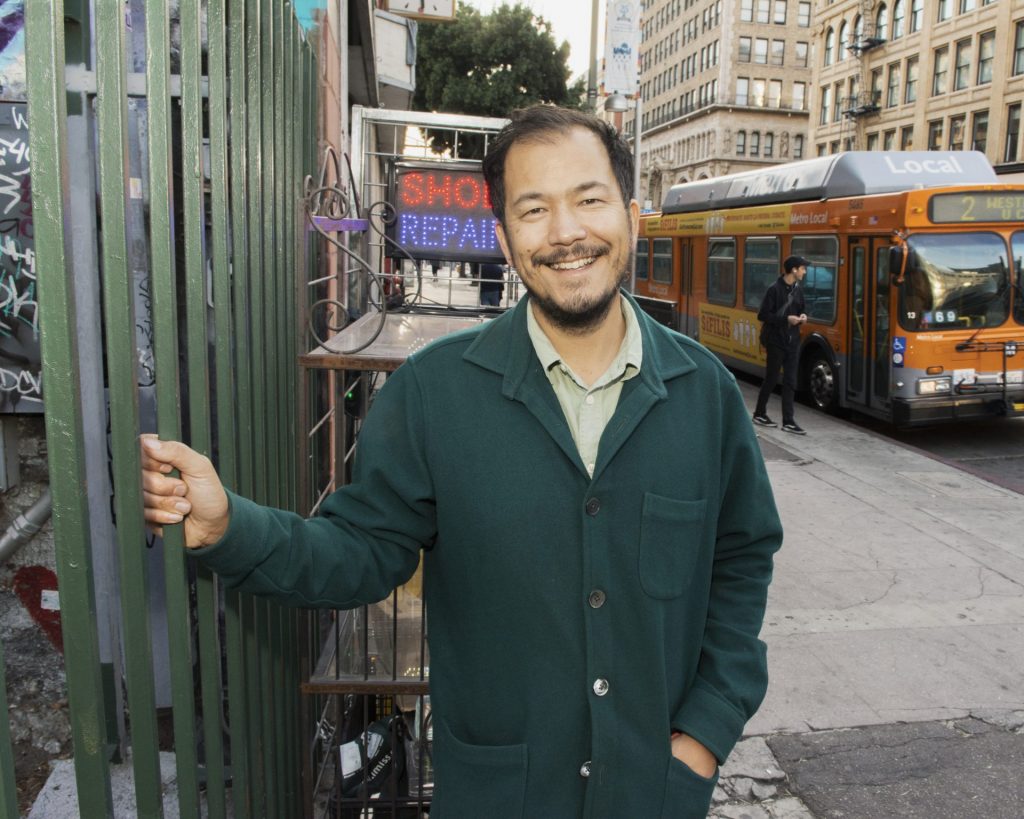
Rosten Woo is an artist and designer whose work connects people to place and builds community agency. He works in long-term collaboration with community-based organizations, advocacy groups, and governments to develop projects that help people situate themselves in complex systems and make group decisions. His inquiry considers how culture creates the groundwork for social cohesion and collective capacity for democratic action in Los Angeles. He believes that building and shifting culture is one of the most important means we have of working toward the world we want to live in and for preparing the ground for the world that can’t yet be built.
Fellowship Summary
My Stanton inquiry began with a set of questions about how we create a culture of democracy in Los Angeles—what are the cultural components of democratic practice? How do we tell the story about our place and our place in it? How do we develop deeper democratic habits and practices? What information or orientation is required for meaningful democratic inclusion? I pursued all three of these threads simultaneously, though some moved forward at different times.
In my process I learned how very interwoven the three strands of my inquiry were. Visiting sites of great trauma and collective struggle and triumph—from Jackson, Mississippi to Kigali, Rwanda—I learned how deep the connections were between civic memory and democratic practice. I learned how much these narratives build on one another and how contemporary experiments in radical democracy are deeply rooted in generations of cooperative struggle. For instance, contemporary innovations like the People’s Assemblies of Cooperation Jackson are deeply indebted to organizing from the Civil Rights Movement and reflect how slow and deliberate these projects have been. How palpably present the past still is.
I was also able to connect with a burgeoning global movement of participatory democracy. From the participatory budgeting movement in the United States and South America, to folks working on computational democracy in Taiwan, the municipal movement in Spain, as well as innovators reimagining democratic institutions in America, I acted as a thought partner with Danielle Allen on a series of op-eds for the Washington Post on reimagining the US House of Representatives. I also connected and learned from organizations like Monument Lab, who are at the forefront of reconsidering the commemorative landscapes in America and abroad, as well as organizers from Indigenous and immigrant communities across LA thinking about what it means to tell the story of this place in a way that respects trauma and nourishes hope.
Meanwhile, through the time afforded me by the fellowship, I was able to play a role in some ongoing projects designed to bring forth truer histories of this place—working in collaboration with Indigenous and immigrant communities and building bridges between them. I imagine this thread of my work will continue long beyond this year’s crop of projects—working with the Mayor’s Office on a recommendation for public processes and civic memory, running a public program and public mediation process reconsidering a WPA-era mural in Santa Monica, and telling the story of the 1871 Chinese Massacre in Downtown LA. Surprisingly, this last year, I’ve worked almost exclusively in this mode of public facilitation, barely producing any of my own visual work. I’m eager to fold these new modes back into my visual art. Perhaps it’s a bit of exhilaration of the slow thaw and return to public gathering and in-person connection, but I have found it invigorating to be working so much with public processes and dealing with large groups of unpredictable people.
In this way, my inquiry dovetailed with several other Stanton inquiries. The connections between participatory democracy, worker-owned co-ops, Mutual Aid, and the Just Economy movement were deep and compelling both here in the United States and abroad. I’m happy to be in dialogue with that local, growing movement to assemble these kinds of institutions—organizations that increase personal agency and democracy while expanding meaningful work, shared prosperity, and collective building. The road ahead looks like supporting these kinds of projects however possible.