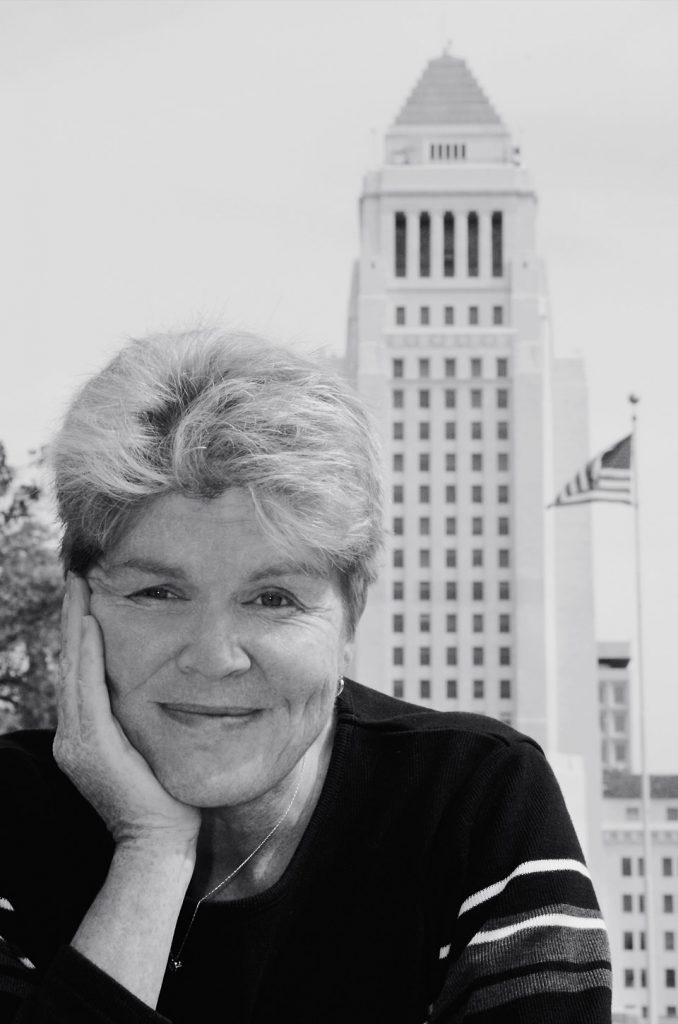
Torie Osborn is the former Executive Director of the Liberty Hill Foundation, which partners with Los Angeles grassroots organizations to combat poverty and injustice, and later served as its Senior Advisor to Philanthropic Programs. She has also served as Special Advisor to the Mayor of Los Angeles, Antonio Villaraigosa, linking the Mayor’s office to the philanthropic community.
“Los Angeles has been named both America’s poverty and wealth capital,” said Torie, “I will seek to identify and implement innovative policy ideas on complex issues such as economic development, homelessness, and education through improving public-private partnerships and increasing coordination and communication between local government and the nonprofit and philanthropic sectors.”
* Torie is now retired.
Fellowship Summary
The intractable problem I explored is the gap between local government and the independent sector (particularly philanthropy) that undermines effectiveness in solving deep social problems—just as those problems are increasing in scale and complexity and require high-level collaboration, since resources and knowledge are spread across sectors. My intention was to identify an issue that could become a laboratory to test some of my hypotheses about helping bridge the gap once I understood it better. I was handed a golden opportunity: shortly after I began my position as Senior Advisor to Mayor Antonio Villaraigosa in January 2006, the Mayor appointed me his point person on homelessness for a year. During the course of the Fellowship, I was able to put into practice some new approaches to developing top-level collaboration.
Research: I met with over 100 people in nonprofits, philanthropy, and local government. I visited New York City (twice), Oakland, San Francisco, and Denver. I presented some findings to Northern California Grantmakers, San Diego Grantmakers, and at several conferences.
KEY LEARNINGS: Analysis, Context, Framework for Action
1. The Sorry State of Local Government:
a) NO MONEY! I was shocked and dismayed by the profound and tragic impact of 30 years of conservative, anti-government “starve the beast” fiscal policies. Particularly in contrast to the bold progressive agenda of the Mayor, it was painful to see the realities of city government after 30 years of Proposition 13 and federal and state cutbacks. Government cannot fund sufficient policing and fire needs, let alone housing for the homeless or mass transit. For example, it took one full year to get 11 new trash cans to Skid Row. The capital dollars (4,400) were available through bond funds, but the costs of trash pickup could not be added to an overwhelmed operating budget.
b) FRAGMENTATION RULES. So-called “progressive era reforms” have resulted in a fragmented government that may prevent concentration of power but makes it virtually impossible to solve complex problems. Los Angeles has LAUSD (budgeted $10 billion), City ($7 billion; $14 billion including airport, port, DWP); and County ($21 billion) with separate cultures, bureaucracies, and no history of working together. Not to mention structural competition between Mayor and City Council offices, along with 49 separate citizen commissions. To make matters worse, decreased public revenues have only reinforced a counterproductive and competitive culture of siloization within both City and County government as departments hunker down to protect diminishing resources and purview.
2. Different Cultures:
The culture of government is diametrically opposed to the culture of philanthropy. Government is reactive, noisy, and, most of all, operational. People do not have time to THINK or PLAN in government—they act! It is not by nature a “learning organization.” Philanthropy is the opposite: planning, learning, and evaluation are valued, though sometimes philanthropy reflects so deeply that it stops moving altogether. Further, there is a MUTUAL OBJECTIFICATION. Government ignores the knowledge within philanthropy and sees it merely as an ATM; philanthropy sees government as impossibly bureaucratic and, even starved, as a huge, unwieldy behemoth.
3. The Nonprofit Sector is Devalued:
Even though the nonprofit sector represents 5% of the jobs in the LA economy, it is off the radar in terms of economic development at LA City. Large nonprofits are seen as community partners, but city-funded service nonprofits on the ground are seen too often as barriers to progress, protected by political patronage by City Council members or County Supervisors from embracing state-of-the-art service models. Unfortunately, there is a grain of truth in this. For example, for years, LA resisted the paradigm shift made by every other city—from shelter/emergency services to housing for the homeless (from “managing” to “ending” homelessness)—because of an entrenched nonprofit shelter industry protected by elected officials. This negative experience with nonprofits gives them a bad name in City and County government. There is much work that needs to be done to turn this perception (and reality) around. A positive shift has been affected with the Mayor’s office partnering with community-organizing nonprofits (as opposed to service providers) on the Mayor’s education (parent organizing groups), housing (tenants rights and housing advocates), and environment (Green LA, the 70-organization coalition managed by Liberty Hill Foundation) programs, but those groups are not dependent on government funding.
KEY LEARNINGS: Implementation
Working on the huge problem of homelessness was my laboratory for my Stanton Fellowship, as well as some other initiatives I worked on (banking the unbanked; affordable housing plan).
1. IN GOVERNMENT, SLOW AND STEADY WINS THE RACE.
Nearly two years ago, I convened a quiet leadership group on homelessness—with representatives of both City and County, the joint powers authority between the City and County, foundation leaders in philanthropy, leading nonprofit intermediaries, and key nonprofit service providers—that met monthly to strategize and effect the systems change that is needed to turn policy around on this issue. In addition, I set up biweekly meetings between City and County staff to coordinate efforts. Two years later, we are on the threshold of key change. In 2008, a joint City/County NOFA (Notice of Funds Available) for permanent supportive housing will be attempted for the first time—the brass ring of systems change on homelessness!
Critical to this success was philanthropy’s role (quietly, not in the press) in leveraging its moral power to bring political leaders from both city and county together in discreet, behind-the-scenes meetings—over and over and over again. Political will is not enough. Staff capacity, sustained leadership, and key investments by philanthropy in convening, policy research, and moral leadership are critical.
2. BEST MODEL: AN OFFICE OF STRATEGIC INITIATIVES.
So far, I have been unable to get the LA Mayor’s office to implement this, but after studying various models, I have determined that the most effective is in Denver. Mayor Hickenlooper has put together the Office of Strategic Initiatives inside his office, co-funded by both philanthropy and the city. The office has several staff, and it builds and manages major public/private initiatives (programs for youth, homelessness) that involve many nonprofits, multiple city and county agencies, and individual engaged funders. Mayor Dellums in Oakland is setting up something similar.