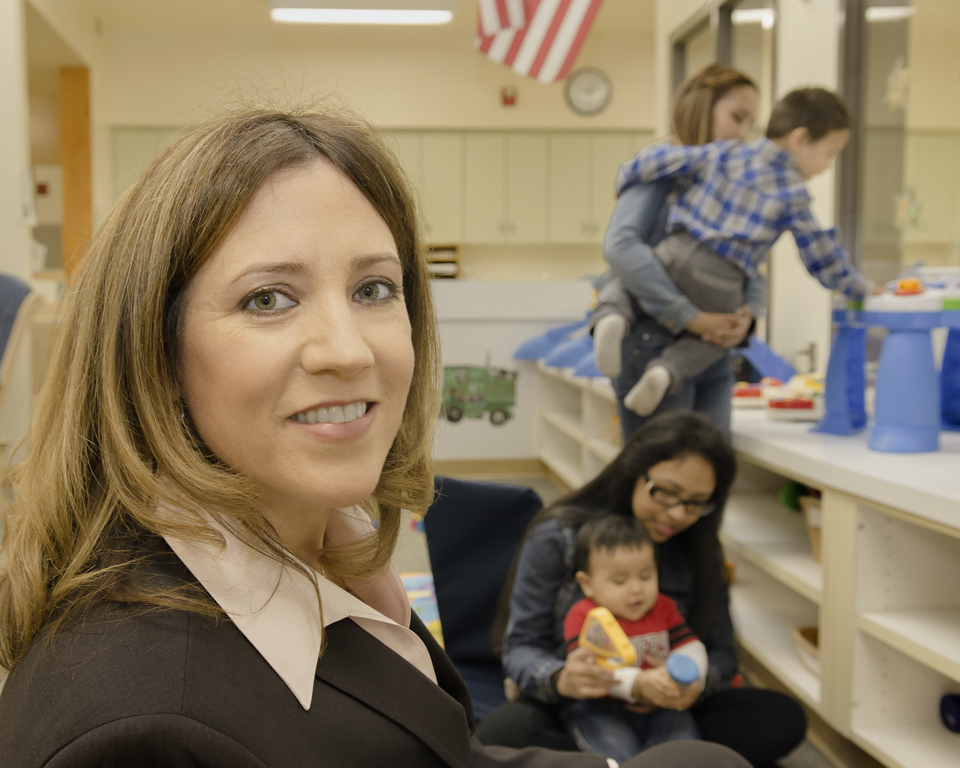
Dr. Debra Duardo is the former Executive Director of Student Health & Human Services for the Los Angeles Unified School District (LAUSD), the second-largest school district in the nation. Debra was responsible for student attendance and enrollment, dropout prevention and recovery, and programs designed to support students with special circumstances that impede school success such as teen parenting, homelessness, foster care, and students unable to attend school because they need to work. She has an MA in Social Work and a Doctorate of Education from UCLA. Debra’s Stanton project focused on how best to engage parent involvement to combat K-1 absenteeism, a strong predictor for high dropout rates.
* Debra transitioned out of her role at LAUSD in 2016.
Fellowship Summary
The Challenge: My initial challenge was to improve student attendance and, more specifically, to reduce chronic absenteeism of LAUSD’s youngest students: kindergartners. My proposed goals were to:
- Increase my understanding of the scope, nature, and impact of chronic absence in Los Angeles and other cities.
- Establish an Early Chronic Absence Prevention Task Force.
- Identify and document effective strategies and programs that address and prevent chronic absence, and translate this knowledge into a School Readiness and Absence Prevention Toolkit.
The Proposal: My initial proposal included conducting a literature review on school readiness, parent engagement efforts, and programs to improve school attendance. In addition to the literature review, I sought to better understand the extent of the problem by gathering and analyzing student attendance data. This involved data from LAUSD, other districts, and the Census. I also proposed learning about best practices by visiting other school districts and conducting interviews with experts in the field of education and school attendance, as well as attending conferences to support my inquiry. A focal point of my proposal was to explore how to engage parents in a meaningful way, as well as to hopefully change their behavior when it comes to when and under which circumstances they allow their children to miss school. Finally, I proposed establishing a task force to help me through this process.
The Stanton Journey: I began my journey by conducting an extensive literature review on school attendance, where I found an abundance of research and evidence-based practices to improve attendance and address chronic absence. The literature varied, including research documenting the negative effects of absenteeism—first on student achievement, then on students dropping out, and finally on social effects, such as criminal activity, the use of alcohol and drugs, sexual activity, and teen pregnancies. Additionally, I found critical information on the cost of such absenteeism to school districts and to the general education system. I also reviewed research regarding absenteeism and its effects on students of different ages—more specifically, absenteeism’s effects on elementary school students and Kindergartners, who are often thought to be too young to be negatively affected by absenteeism. Ultimately, I found information regarding solutions offered to address this problem as well as suggestions on how to involve parents as partners in improving school attendance.
One of the key researchers and advocates of parent involvement is Hedy Chang, Executive Director of Attendance Works, a national organization leading the work on student attendance. I interviewed Hedy, a dynamic leader in the field, and we immediately connected. I shared my Stanton project and we agreed to work together to find solutions to address chronic absence in Los Angeles. Hedy introduced me to Charles Fields from the California Endowment, which led me to other leaders in Los Angeles involved with initiatives aimed at closing the achievement gap, such as The Campaign for Black Male Achievement and The Campaign for Grade-Level Reading. This work led to our partnership on a research project that involved three school districts: LAUSD, Sacramento, and San Diego. We identified kindergartners with chronic absence and placed them into quartiles to compare those with the most chronic absence (4th quartile) with kindergartners who are chronically absent, but not as severely so (1st quartile). As a result of this research, we were able to take a deeper look at what impacts student attendance among the chronically absent. We learned that there are strong correlations between student attendance rates and aversion to attendance because of safety concerns, school climate, and teacher-student relationships.
In order to learn more about improving attendance, I visited other school districts that were successful in improving their attendance rates. I had the opportunity to visit Atlanta, Kentucky, Albuquerque, Chicago, and Oakland to meet with key leaders in education and the community working on this issue. I was also able to attend several national conferences emphasizing school attendance, including the National Dropout Prevention Network and The National School Social Work Association. While in Atlanta, I was advised to contact Todd Rogers, a professor and researcher at Harvard University. Professor Rogers conducts cost-effective research to support practitioners in education. He and I discussed the role parents have when it comes to school attendance and agreed to work together on a research project to measure how parents respond to Notice of Truancy Letters (NOT letters), which school districts are required to send per state law to parents when their child is truant.
Working with Professor Rogers, we designed five different NOT letters, each containing progressively more gentle language and with added support for parents, such as tips on how to improve their child’s attendance. We then mailed over 150,000 NOT letters, randomly selecting which letter parents would receive. Some parents received the original NOT letter, while others received one of the redesigned letters.
Where You Are Now: I am now at the point where I need to analyze the data to determine which letter has the greatest impact on improving student attendance. I thought I would be able to complete this analysis in January; however, after meeting with Todd Rogers, he explained that we need to wait until the end of the school year to conduct the analysis. We must allow time to see if the parents who received the NOT letters changed their behavior when it comes to sending their children to school. We won’t be able to measure this change unless we allow time to see if, as the school year progresses, there is a change in the students’ actual attendance. Therefore, the plan is to analyze the data at the end of the school year (June 10) to determine which letter had the greatest impact. I will continue to work with Professor Rogers to complete this analysis and am eagerly awaiting our findings. If indeed we do determine that one letter is more likely to improve attendance than others, this will have a significant impact on not only LAUSD but also on school districts throughout the state of California as we continue our efforts to improve student attendance.