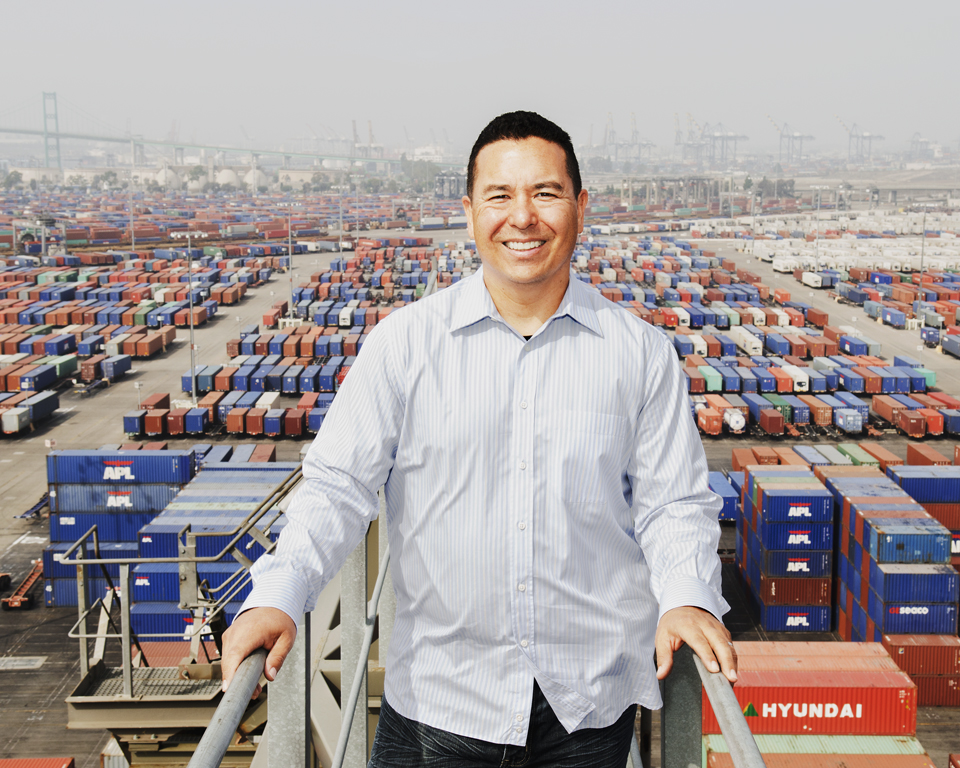
Madeline Janis is the Co-Founder and former National Policy Director of the Los Angeles Alliance for a New Economy (LAANE). Under her stewardship as Executive Director from 1993 to 2012, LAANE became an influential leader in the effort to build a new economy based on good jobs, thriving communities, and a healthy environment. Prior to founding LAANE, Madeline served as Executive Director of the Central American Refugee Center (CARECEN). Before joining CARECEN, she worked at the law firm of Latham & Watkins on commercial litigation and land use matters. She received degrees from Amherst College and UCLA Law School. Madeline’s Stanton project investigated how investment in transportation infrastructure could help create greater domestic manufacturing capability in Los Angeles.
* Madeline transitioned out of her role at LAANE in 2013.
Fellowship Summary
The Challenge: As I developed my initial proposal for the Stanton grant, I was grappling with a thorny problem in both the LA and national economies: the globalization of capital and the disappearance of good manufacturing jobs that had been foundational for the growth of LA’s economy. In particular, with the approval of measure R by LA County voters in 2008, the challenge/opportunity to grow manufacturing jobs became apparent. LA had begun to embark on an amazing program to rebuild and expand our public transit system, yet most of the equipment purchased by LA transit agencies was manufactured overseas. The initial general question that I posed was: how can we use public procurement to rebuild and improve manufacturing jobs and opportunities in Los Angeles and the country? In particular, I was looking at the purchase of major equipment by the LA County Metropolitan Transportation Authority (LA Metro) for the expanding public transit system.
During 2012 and 2013, after stepping down as Executive Director of LAANE, I did extensive research on policy options for transit agencies to include job creation and equity language in large procurements of equipment. That research had led to the development of a policy that was piloted by LA Metro and then reviewed and approved by the US Department of Transportation for use by transit agencies making procurements with federal funds. By the end of 2013, I had helped to create a new project called Jobs to Move America (JMA), which I believed could be the vehicle to advance a program around public procurement and good manufacturing jobs. But what would that program look like?
In addition, after looking at the companies manufacturing buses and trains for the US market, it became clear that nearly all of them were foreign enterprises with home bases in either Europe or Asia. Given that capital has become global, how could we develop an effective campaign to win good jobs and increase economic development related to transportation investments when all of the decision makers were in Berlin, Paris, Tokyo, and Beijing?
The Proposal: I initially saw the Stanton Fellowship as an opportunity to educate myself and learn. I knew a lot about economic development, but in the US, economic development is so often associated with real estate development. I was more interested in using industrial policy to achieve the improvement and expansion of manufacturing jobs. So what was the experience in other countries, and particularly those countries where the major manufacturers were located? To what extent did public procurement form a part of industrial policy? And what were/are the other elements of strong industrial policy? For example, workforce and vocational development, support for innovations in research and development, the building of clusters, etc.
Secondly, I wanted to analyze and learn about the major bus and train manufacturing companies doing business in the US market. I wanted to know where around the world they had the greatest market share, where they were primarily bidding, and where their factories were located.
Thirdly, I wanted to visit Europe and build relationships with key stakeholders to help me and my colleagues learn and develop strategy. Particularly with unions, companies, and key opinion leaders.
Finally, after visiting Europe and completing my research, I proposed to follow up by building ongoing relationships with the targeted companies and the unions that represent their employees in their home countries.
The Stanton Journey: For the first six months of my Stanton journey, I read a huge number of books and articles, and conducted a number of interviews with academic, transportation, and industrial policy experts around the globe. I started out by focusing on European industrial policy. I read extensively on urban development, transportation systems, and manufacturing clusters in Germany, England, France, Spain, Sweden, and even the Netherlands. I wanted to get a broader sense of how industrial policy had been developed post World War II in Europe, through both national programs and the European Union. I also wanted to understand how the transportation infrastructure of Europe, which is extraordinary, was built through interconnected infrastructure projects across Europe. I ended up focusing more specifically on Germany and France, where I decided to focus my travels.
During my Fellowship, I also attended several industry conferences with both national and international transportation leaders. I also joined the American Public Transportation Association (APTA) to deepen my relationships and learn from company leadership and transportation policymakers. I visited bus and rail car factories in South Carolina and in upstate New York to talk about the interconnectedness of their business operations, public procurement, workforce development, and regional economic growth.
I did extensive planning for my February 2015 trip to Europe. I researched and solicited support from two European foundations—one in France, the other in Germany—to get better access to key officials and additional support so that I could bring a colleague along. Fortunately, I was successful and won support from these foundations, who assisted us in setting up numerous meetings, arranging for internal transportation within each country, and providing interpretation for us at the meetings. During this trip, it became clear that the most relevant model to the Jobs to Move America strategy was the German industrial model developed in the past 70 years since World War II.
Where You Are Now: During the last part of my Fellowship, I began the work of integrating both the research and the experience into the overall Jobs to Move America campaign. Attached is a strategy chart that has evolved from this experience. One of the key lessons I learned is that it is possible to build a global community and labor program to deal appropriately with the global nature of manufacturers competing for contracts in the US. As part of the Jobs to Move America strategy, we have incorporated a global component and are planning extensive trips and relationship-building investment with companies, unions, and opinion leaders in China, Japan, Germany, Eastern Canada, and eventually, Spain.
After the two years of building out the program, raising funding, and winning numerous policy factories, Jobs to Move America separated from LAANE (which still remains JMA’s fiscal agent) on January 1, 2016. The agency now has 13 staff positions and is located primarily in Los Angeles, but also has staff in Chicago and New York. The work of the Stanton Fellowship has been fully integrated into the permanent strategy of Jobs to Move America.