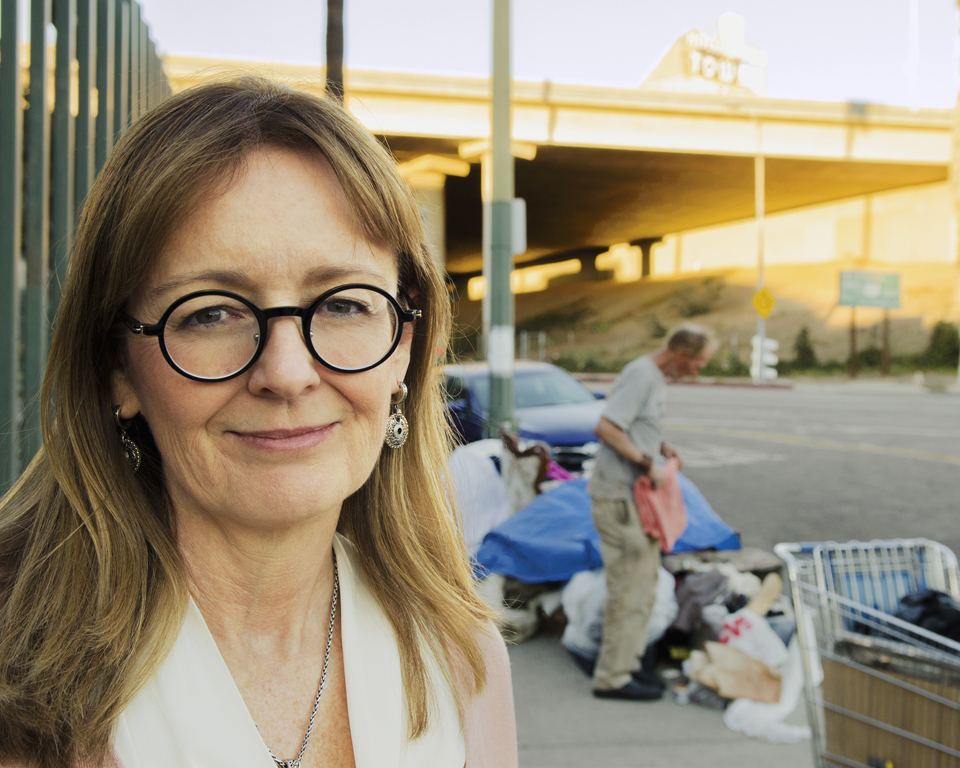
Kerry Morrison served as the Executive Director of the Hollywood Property Owners Alliance (now The Hollywood Partnership) for 22 years, where she managed two Business Improvement Districts. In her role, she maintained close liaison with local government, homeless service providers, and community organizations. During her tenure, she became intimately acquainted with many chronically homeless and severely mentally ill people living on the Hollywood streets, and she has worked with a coalition to seek transformation in the lives of a few. She sought to find a new path for helping homeless individuals suffering from mental illness obtain the medical attention and supportive services they needed.
* Kerry transitioned out of her role at the Hollywood Property Owners Alliance in 2019.
Fellowship Summary
The Challenge: Beginning in 2010, a coalition of the willing worked intentionally to identify chronically homeless individuals in Hollywood who were most vulnerable and needed to be off the street. Despite our best efforts, there was a cohort of people we could not reach. These were the most severely mentally ill, existing outside of any established system, and they were left to languish or die. In 2013, when we realized that this “super chronic” group of homeless people remained impervious to traditional interventions, we identified the “Top 14” people for whom we had the greatest concern. For my Stanton inquiry, I wanted to understand why it was so hard to help them.
The Hunch: To describe my inquiry, I relied on the analogy of a rubber band ball. It was guided by the notion that the person trapped within all the entanglements of laws, judicial rulings, procedures, privacy rules, insurance requirements, and bureaucracy could be freed if I could just figure out which of those laws or rules could be removed or at least loosened. Armed with that knowledge, I could make a case for change.
The Proposal: To tackle this inquiry, I proceeded to study the history of deinstitutionalization in America. I made a list of the authors I needed to read and people to meet to expand my knowledge of America’s mental health system. I found a model for “design thinking” that encouraged me to keep searching for possibilities and avoid limiting the search or committing to a solution too hastily.
With the lessons learned from keeping track of the Top 14 case studies, I had clues into areas where improvements could be made. I tested those assumptions against how the system currently worked and what stood in the way of reform. Because I was not an expert in this field, my stories informed the questions I asked.
The Stanton Journey: Stanton encourages networking, so I followed virtually every lead I stumbled upon. This led me to explore vistas I didn’t know existed. At first, I found myself limiting my search to domestic sites—looking for another locality in America that was “doing it right.” It never dawned on me that revolutionary change would come from another country because I felt that any solution proposed for LA would have to conform to American norms and laws.
In Year One, I dived deeper into our LA County system, and I visited Denver, Miami, Washington DC, Palo Alto, and Morgan Hill. Three focus areas surfaced: the fragility of the county’s board and care system that houses many people with severe mental illness, the lack of a coordinated approach toward defining the grave disability statuses of chronically homeless people, and the simplicity of the Hollywood Top 14 system which emphasizes building sustained relationships with the severely mentally ill.
But the Durfee Foundation wisely encourages you to cast your net wide, so I planned a trip overseas. I visited Geel in Belgium, a city that has a 600-year history of fostering people with mental illness in private homes. Next, I was led to Trieste in Italy, a World Health Organization Collaborating Centre heralded for their exemplary practices in caring for their mentally ill neighbors. In Trieste, when they closed their mental institution in the 1970’s, they built a kind of community care system that we never have in the United States. The trip to Trieste was earth-shattering, so when I got word that there was an international conference scheduled in November 2017, I corralled a group of leaders from LA County to return with me to see this remarkable system firsthand!
Our mental health system is ripe for change. We are fortunate in that in Los Angeles, there are thoughtful, compassionate, forward-thinking leaders who are looking for new ideas to champion. So how do I stay involved?
Where I am now: First, with respect to the Trieste Delegation, I have pledged my volunteer commitment and to continue to coordinate their meetings and collaborations. I am working on a set of guiding principles and a “new language” that we learned in Italy which may be transferable to a prototype in Los Angeles. Finally, stirred by the power of storytelling, I am working on an edited film of the group presentation by Trieste Delegation upon their return to LA so that this inspiration can be shared widely. I remain committed to tracking the case studies of the Top 14.
Second, with respect to the board and care crisis, I have completed the report that I started in 2016. I will be presenting it in early 2018, with my two co-committee members, to the County Mental Health Commission, LAHSA, the Home for Good Task Force, and the HHH Citizen’s Advisory Committee.
Hope is in the air.