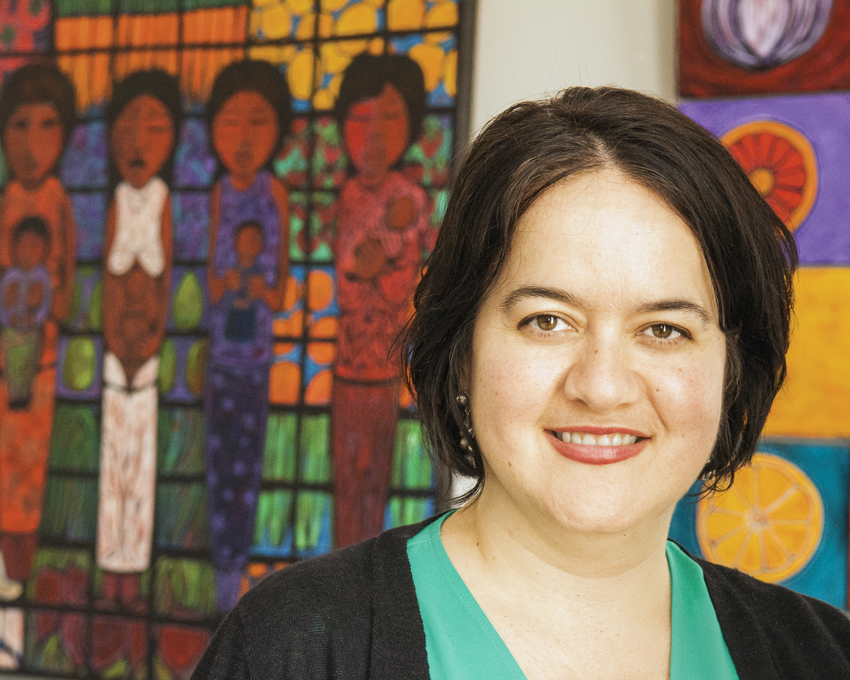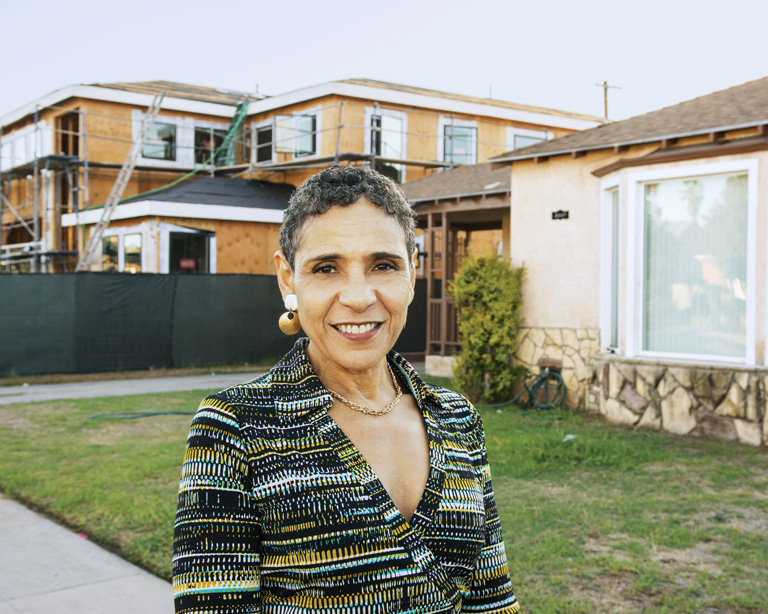
Mary Lee is the former Deputy Director of PolicyLink, a national research and action institute advancing racial, economic, and social equity. Her inquiry focused on the rapid changes in real estate and housing in LA and sought to identify economic strategies that prevent the negative impacts of gentrification on African American families. Mary drew on her experience as a housing attorney and public policy advocate to find innovative solutions.
* Mary is now consulting in semi-retirement.
Fellowship Summary
The Challenge: Gentrification is sweeping across Los Angeles at a record pace. People of color are being displaced as more affluent white residents move into areas they previously overlooked. Black neighborhoods have been hit particularly hard, and the consequences can be devastating. Once displaced, few options exist for Black residents; many are forced out of the Los Angeles region altogether. Others are rendered homeless, which is evidenced by the shocking rise in Black people experiencing homelessness. Although Black people make up only 9% of the population of LA County, they make up 40% of the county’s homeless population. While homelessness may be an expected consequence of displacement, it is by no means the only one. There is much more at stake for Black people than increasing the supply of affordable housing and keeping rents low. It isn’t just about housing, and the harm is not solely from displacement. Every aspect of life for Black people is impacted: jobs, economic stability, education, social connections, cultural expression, health and longevity, and even political power.
For Black people, the phenomenon now referred to as gentrification and displacement is not new, nor is it merely a function of the real estate market. It cannot be disconnected from the brutal history of racism, genocide, colonialism, and captivity. It cannot be disconnected from enslavement, from the more than 400 years of theft of Black land and labor, or from the public institutions and private conduct that have subjected Black people to injustice, terrorism, violence, and horrific atrocities. On multiple occasions, Black people have been forced off of their land, out of their neighborhoods, locked out of certain areas, and isolated into others. It has happened repeatedly across Africa, across the US, and across Los Angeles. Moreover, it has not happened by accident. It is instead the objective of a rigged system designed to extract wealth and productivity from Black people in a manner intentionally designed to degrade and dehumanize.
This is the challenge I sought to address: putting the phenomenon of gentrification/displacement into a larger context, and identifying ways to prevent the harm to Black people—financial and otherwise—that typically results. My aim was to find ways for Black residents and business owners throughout Los Angeles to navigate the economic circumstances unfolding around them in a manner that would benefit them instead of victimizing them.
The Hunch: My hunch was that the most important constituency to target for this effort was not the usual suspects—not policy makers, government officials, philanthropy, or developers. The crucial target has to be the Black people who live in LA—in neighborhoods such as Leimert Park, Inglewood, Vermont Knolls—who are not benefiting from the rapid transformation underway in their communities. My sense was that there are no unapologetically Black spaces for those living through these circumstances to discuss them, explore their options, and form opinions. There are plenty of forums that are talking about gentrification and displacement, but only in abstract terms of what public policy should be about issues such as rent control, housing production and density, and market forces. But there has not been a venue that encourages Black people to examine our history and make connections between the various eras we have survived—particularly through the lens of land, wealth, economic stability, and political power.
As Black people, we need to consider a timeline that makes linkages between forces such as conquest and capture, forced dislocation, enslavement, Jim Crow, zoning laws, redlining, urban renewal, redevelopment, and today’s gentrification and displacement. My hope is that enhancing awareness of these connections will spur Black people to act collaboratively to upend the effects of centuries of racist systems and find new pathways to economic security and financial stability. Specifically, collective ownership of residential and commercial property.
The Proposal: I approached the project in a fairly conventional way. I wanted to read everything I could get my hands on, to immerse myself in books about discriminatory policies in banking and real estate. I also planned to talk with economists, to learn about financial products and services, and perhaps learn how financial products that meet the needs of Black people could be crafted. I also wanted to visit Black communities across the country to see various stages of gentrification and displacement—some just beginning or already underway, and others where Black neighborhoods have been almost completely erased.
The Stanton Journey: About midway through my Stanton journey, I took on a related project: researching and lecturing on the history of mortgage redlining and related US public policies that are racially motivated and deliberately designed to disadvantage Blacks and other people of color while intentionally privileging whites. Conversations about redlining, gentrification, and displacement sparked introductions to people working on related efforts. My path didn’t really change, but my thinking about how intractable systemic racism is—and how it is woven into the fabric of the nation—deepened. It became even more evident that the history of these issues has been fragmented, minimized, and distorted, and that myths about Black economic and political power have misdirected attention away from strategies that have the potential to make transformative change.
I kept these issues in mind as I took a literal journey. I traveled to a number of Black communities in the US, including: Washington DC, Detroit, New Orleans, Harlem, Oakland, Boston, Jackson, Mississippi, and Portland in the states, as well as the Caribbean and Ghana. My visit there coincided with the Year of Return, a commemoration of the 400-year anniversary of the arrival of the first enslaved Africans captured and transported to the US. The principal take away from all I’ve experienced is the power of collaboration and collective action. Collective methods echo throughout the past and present in the culture and experiences of Black people in the diaspora and across the globe. In the face of growing economic inequity, returning to our tradition of collective action offers Black people a way forward.
Where I am Now: As my fellowship draws to an end, I am gratified to see that this topic is resonating broadly. Yet, I also realize there is a high degree of urgency given the vulnerability of Black neighborhoods. I am more convinced than ever of the validity of my initial inquiry—namely, that a dialogue among Black people will lead to a clearer understanding of the genesis of current circumstances, as well as foster a greater interest in collective action for economic development and cooperative ownership by Black people.
I used the resources from the fellowship to produce a brief video and a few podcast episodes on these topics that I am excited to share with residents of Black neighborhoods in LA. I have also convened a core group of activists, academics, business owners, and residents who are interested in forming a study group to examine strategies that have the potential to shift the paradigm from gentrification and displacement to one of economic participation and prosperity for members of the Black community.