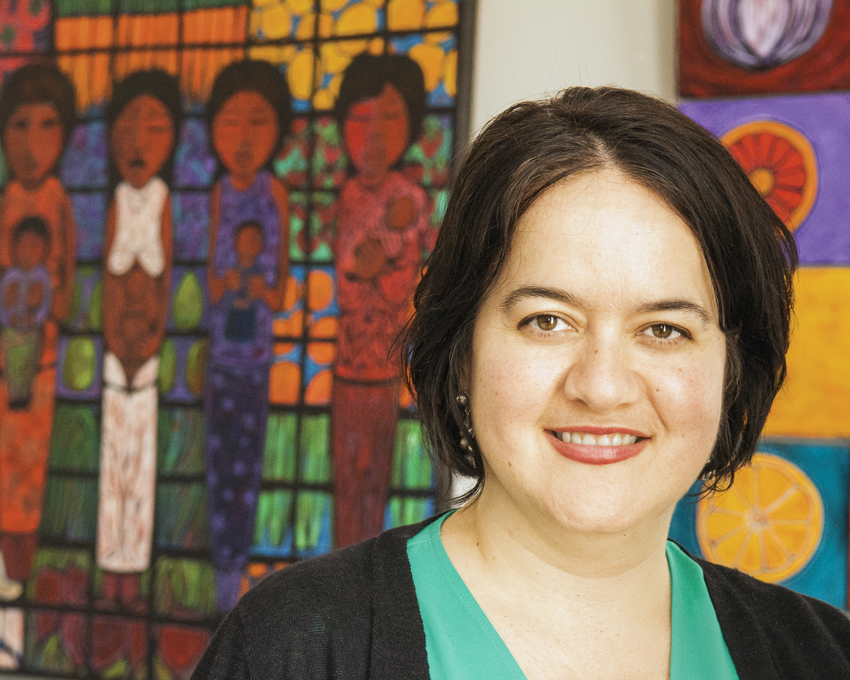
Molly Rysman is the former Housing and Homelessness Deputy for Los Angeles County Supervisor Sheila Kuehl. She noted that although more money than ever was going into homelessness and more housing was being built, the number of people on the street remained dismayingly high. Her hypothesis was that homelessness can’t be solved in vacuum, and a fresh assessment of the causes of and solutions to homelessness in 2017 and beyond was necessary. New funding from Measures H and HHH made this a ripe moment for reassessment.
* Molly transitioned out of her role as Deputy in 2022.
Fellowship Summary
Homelessness is the greatest challenge facing California. I have spent my career working to end homelessness, but that goal feels more elusive today than it did when I started in this field more than 15 years ago. That is because something shifted around 2014. We didn’t know what, but we could feel the difference. Many more people were falling into homelessness than we had ever seen before, and so many of them had spent their lives gainfully employed, or were even employed while experiencing homelessness.
I started my Stanton journey the same year Los Angeles County passed Measure H, the ¼ cent sales tax to fund services to address homelessness. Measure H was a huge step forward, but I knew we would be funding interventions developed before the homeless crisis reached its zenith. I had to ask the question: does the global housing crisis demand that we change how we respond to homelessness?
I started with a more simple question: what happened? I poured over the latest papers by the leading economists studying housing markets. I started to understand the fourth industrial revolution and what it meant for cities to shift to a knowledge-based economy. I began to connect what was happening in Los Angeles to the rise in homelessness in European cities and could see that this was a global phenomenon. New research shows how rising rents drive inflows into homelessness in cities that cross a rental housing affordability tipping point.
I knew from the beginning of my fellowship that I wanted the collective wisdom of my community to inform my Stanton inquiry. My first act as a Stanton Fellow was to establish a Community Advisory Circle. That was followed by conducting oral histories with people who had lived the experience of homelessness. I decided I also wanted the wisdom of emerging leaders in the field who weren’t wedded to what we were already doing. We created EmergingLA, a monthly mentorship/policy salon where emerging homeless leaders could explore their ideas about the causes of and solutions to homelessness.
The collective wisdom that emerged from these conversations illuminated that economics alone could not explain what was happening. A voice inside me told me to go to Alabama for the opening of the Equal Justice Initiative’s Peace and Justice Memorial. I couldn’t explain how a monument to racial terror was connected to homelessness, but something was calling me there. Listening to that tiny voice changed the course of my Stanton and how I understood my work.
The opening of the Peace and Justice Memorial was life changing. But beyond the profound experience of understanding how slavery continues to define our country, I began to be able to make the connection between the commodification of land and structural racism. We have a toxic relationship with land in this country because we have deeply vested beliefs about who is allowed to prosper and belong, and who is not. Land is the most powerful tool to enrich or to strip a person—or group of people—of resources. For the first time I could trace the line from Native American genocide to slavery to homelessness. We are simply continuing 500 years of casting people out.
This isn’t rocket science. Native American and Black people experiencing homelessness know this in their bones. But professionals working in homelessness often ignore this wisdom. Now that I could feel this in my bones too, I had to find a way to communicate this narrative to my community and give them the tools to address the commodification of land and structural racism. We settled on the framework of housing justice.
I concluded my fellowship by teaming up with an amazing team of people who knew homelessness both professionally and personally to host a Housing Justice Summit. We shared the journey I had been on, personal stories and expression, and explored how to create solutions to homelessness rooted in housing justice. We also captured and shared the ideas from the Summit through the Housing Justice LA podcast.
As I continue to work toward an end to homelessness, I now strive for deeper solutions. Because I worked so closely with my community throughout my Stanton journey, we have shared language and goals around housing justice that we work toward together. We are starting to hear whispers of housing as a human right reflected locally and nationally. Now we begin the work of turning those whispers into a roar.