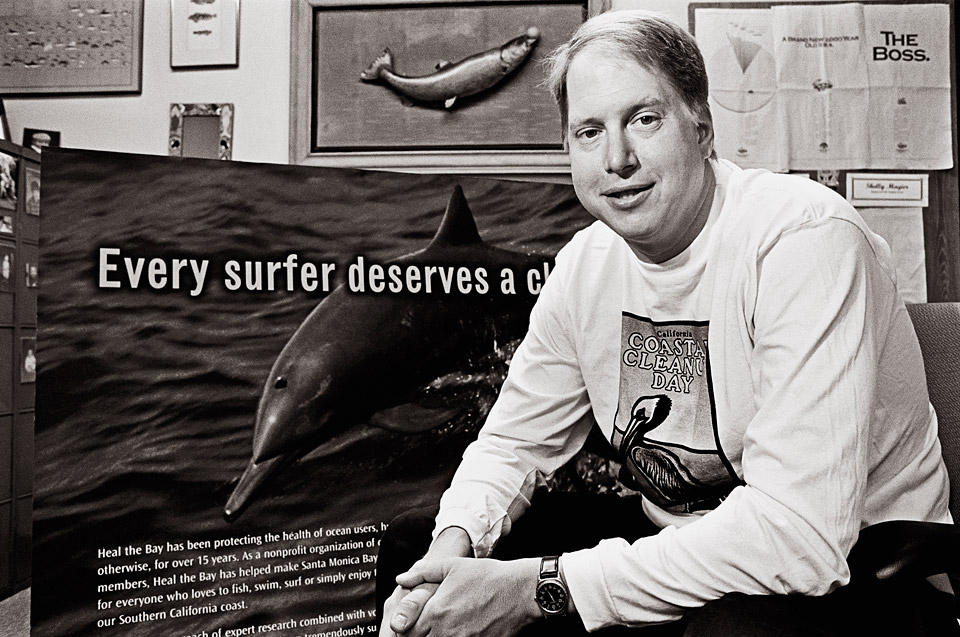
Mark Gold is the former Executive Director of Heal the Bay, an organization dedicated to making Southern California coastal water and watersheds safe, healthy, and clean. For his inquiry, he worked on the development of HtBX, a scientific problem-solving consulting arm to Heal the Bay that will lend its expertise to environmental, community and governmental agencies.
“The Stanton Fellowship will enable me to fulfill my dream to have Heal the Bay’s approach of science-based problem solving become a model for other coastal environmental groups,” said Mark.
* Mark transitioned out of his role at Heal the Bay in 2012.
Fellowship Summary
Project Overview
The goal of the project was to develop a mechanism to provide Heal the Bay’s expertise to government agencies and community-based organizations. A major component of the project was to complete a business plan for the program, but the plan won’t be finalized until May 2008. Heal the Bay retained TC Hoffmann and Associates to complete the business plan for the program. The plan’s development includes three phases: market research with a focus on a survey of numerous NGOs and potential funders, analysis of survey results, and completion of the final business plan. Senior staff, including Heal the Bay’s Executive Director, Senior Staff Scientist, and our Executive Assistant, are all now working on the project.
Among the questions that will be answered in the plan are:
- What is the appropriate structure for the endeavor? Should it be within HtB or independent of HtB?
- Who is the appropriate market for the service? Ideally, we’d like to split our services equally between CBOs and government agencies.
- If CBOs can’t pay for expertise, will foundations be willing to fund HtB’s efforts?
To date, Heal the Bay has answered a number of pertinent questions. There’s no question that there is a wide market in the government sector for our professional services. As stated below, we have greatly expanded our efforts to provide technical expertise to government agencies on a wide variety of projects. Also, staff have determined that the range of services potentially provided will be limited to expertise on coastal pollution—especially beaches and stormwater— as well as watershed assessment and environmental education.
The following is a summary of the projects that HtB’s been working on that fit under our goals.
Education and the Environment Initiative (EEI)
The process of developing the EEI curriculum is proceeding near the scheduled pace. Each unit of draft curricula will be reviewed by Heal the Bay, teachers, and professional editors. National Geographic has provided photos and maps for the units as well as substantial video content for environmental education. A number of the draft curricula are currently getting field tested in school districts, and feedback will be used to modify the curricula. The ambitious goal is to finish 150 units by the end of 2008. From there, the units will go to the State Department of Education Curriculum Commission for final approval.
There are still a number of enormous challenges for the EEI and Heal the Bay. One immediate need is for National Geographic to take a more aggressive role in content review and graphic design. Another urgent need is additional funding. Although we received a three-year $150K grant from Edison International to review units, this is not adequate enough amount for the time spent by Heal the Bay.
The biggest challenge may be getting sustainable funding for the State of California to implement the EEI. Surprisingly, we’ve received no significant interest from the foundation community despite repeated outreach to a number of foundations.
Scientific Advisory Committee
I have taken a different approach on this task than originally proposed. I’m a member of the California Ocean Science Trust (Cal-OST), which provides technical expertise to the California Oceans Protection Council (OPC). Currently, the Trust is working with the OPC to create a Scientific Advisory Board that will include 12 to 15 of the leading coastal scientists in California. Additionally, our hope is to create a registry of scientists in California that are working on ocean science issues. I chaired the Cal-OST committee on creating the scientific advisory board, and we set the criteria for eligibility. Applications are currently being reviewed. In essence, one of my major goals is being implemented as a broader process being led by the OPC and Cal-OST.
Beaches
Heal the Bay’s work on beaches continues to expand:
- We partnered with the Southern California Coastal Waters Research Project (SCCWRP), UC Berkeley, and others to complete a multi-year epidemiological study on people who swim in the runoff-contaminated waters of Doheny Beach and Malibu Surfrider Beach.
- We initiated another epidemiological study at Avalon on Catalina. The US Environmental Protection Agency (EPA) paid for us to complete this study. Although it went extremely well from the standpoint of water quality results (highly variable), we were unable to interview enough subjects to complete the study. We will likely continue our work on it this summer.
- Our source identification study with SCCWRP for Los Angeles County on two polluted watersheds in Malibu—Ramirez and Escondido Canyons—was stopped after 6 weeks because of lack of flow. We will continue the effort early this spring.
- Confidentially, I continue to serve as a technical expert to the Natural Resources Defense Council (NRDC) on litigation against the EPA for their failure to develop national beach water quality criteria by the deadline given by the Federal BEACH Act. The case is headed to trial this April.
- Heal the Bay was successful in convincing the State Water Board to fund time for experts to help coastal cities and counties create effective project proposals for the California Clean Beach Initiative. This initiative allocated over $100 million to clean up the state’s most polluted beaches. I have provided expertise on a number of Southern California beaches but have not charged for my services because the amount of time spent on each project didn’t merit it. This may change in the near future.
Stormwater
Heal the Bay signed an Memorandum of Understanding (MOU) with the City and County of Los Angeles and a contract with Geosyntec (a consulting firm) to manage a $330,000 project to develop a quantitative watershed management tool for the Ballona Creek watershed. The tool would allow cities to determine what cleanup technologies are needed to reduce stormwater pollution enough to meet water quality standards. The project is ongoing and has resulted in tools that could be incredibly useful for getting cities, developers, and industries to implement treatment devices designed to meet numeric performance standards and design storm criteria.
The last two years have demonstrated that government agencies are eager to pay Heal the Bay market rates for its work on a wide variety of coastal pollution projects. There is no question that the organization can continue to provide these services in a manner that focuses on projects that advance the goals and the mission of Heal the Bay. The business plan will provide information on whether or not NGOs can use and pay for Heal the Bay’s technical expertise, as well as if foundations are willing to fund NGOs for our expertise on specific projects.