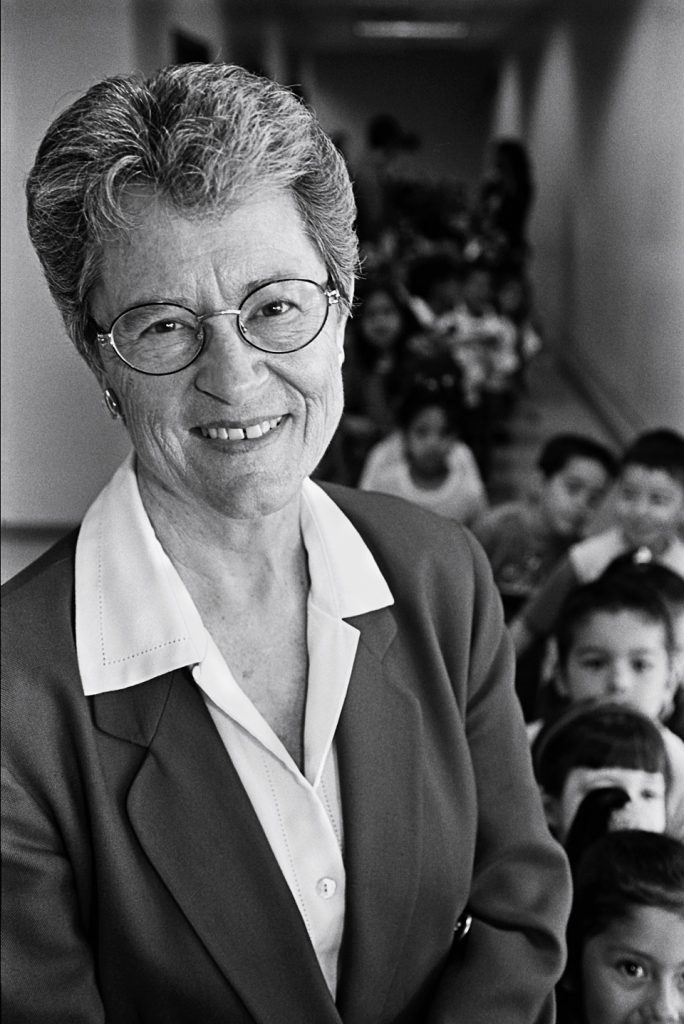
Sister Jennie Lechtenberg is the former Chief Executive Officer of PUENTE Learning Center, a nonsectarian, nonprofit organization offering tuition-free educational programs to students of all ages. For her inquiry, she researched the possibility of implementing adult charter schools in California.
“Statistics prove that adult illiteracy and lack of basic education are rampant in the state of California. I will pursue the idea of creating adult charter schools to provide another venue through which already existing community-based organizations can continue to offer and strengthen fundamental educational services,” said Sister Jennie.
* Sister Jennie is now retired.
Fellowship Summary
My project as a 2006-2007 Durfee Stanton Fellowship recipient was to research the possibility of establishing adult charter schools in California, with PUENTE Learning Center as the pilot study.
By definition, charter schools are privately operated but publicly funded, and they have been freed from some of the rules, regulations, and statutes that apply to public schools in exchange for accountability in producing certain results. Currently, only institutions serving elementary and secondary school students may receive a charter school designation in California.
This project was launched in response to the alarming and growing number of adults in California who are falling behind educationally and are lacking even the most basic skills needed to compete in today’s society. For example, according to the 2000 US Census, almost one-quarter of California adults—five million people—did not complete high school; almost half of that number had no high school education whatsoever.
Steps need to be taken to give this group increased access to educational programs. Without these services, there will be obvious consequences for the economy, including businesses unable to find skilled workers, families unable to afford a basic standard of living, and children living in poverty and lagging behind educationally.
My potential solution was to see if existing community-based educational organizations could be accredited as adult charter schools to supplement California’s current adult education system. This required that legislation be passed.
Community-based educational organizations are perfect for this role because they are typically located in geographic areas that provide services to the underserved adults most likely to need additional education, including adult immigrants, adults with disabilities, disadvantaged adults, homeless adults, incarcerated adults, single parents, and displaced homemakers. By receiving such accreditation, these organizations would provide a larger, more geographically diverse network of facilities that are equipped to respond to adults’ basic educational needs. They would also receive state funding to do so.
Classes in language, computer literacy, GED prep, high school diploma programs, and parenting could be offered. Consequently, businesses would be better able to find skilled workers, families would be able to afford a basic standard of living, and children living in poverty and lagging behind would be given greater opportunities to succeed by having more academically proficient parents.
I approached this project by conducting extensive research on charter applications, legislation, and regulations. I also attended charter school and adult education conferences, and met with a multitude of people in various sectors who could provide valuable information and influence and/or would logically be involved in getting adult charter legislation passed in California. These included officials from the Department of Education in Washington, DC, individuals from or connected to LAUSD, numerous politicians, charter school leaders, representatives of community organizations, and an adult charter school in Washington, DC. The intent was not only to seek their input and guidance, but to also persuade them to become stakeholders in my efforts.
In addition, information was gathered on all aspects of adult education, allowing me to learn as much as possible about current legalities, review successful proposals, incorporate valid input, and adapt my approach and content accordingly to better ensure the sought-after result.
On February 22, 2007, Assembly member Hector De La Torre introduced Assembly Bill 806 to the Education Committee. The bill, which went through various revisions, would have authorized specified local districts to establish and participate in Joint Powers Adult Occupational Training Centers operated as charter adult schools, supported by adult education funds. Although the bill did not pass as written, removing the word “charter” wherever mentioned, a formal collaborative was created between PUENTE and LAUSD through which basic language, academic, and technical skills are being provided to the community in a manner that maximizes the resources PUENTE and LAUSD’s Division of Adult and Career Education respectively offer.
I learned a number of things during my Fellowship, including: a) there remains a critical need to raise the number of educated adults in California; b) the importance of lobbying and having key people present my case to those with the ability to make changes; and c) the difficulty of breaking through longstanding bureaucratic ideas.
The Durfee Stanton Fellowship allowed awareness of this issue to be raised among key opinion leaders. While I did not meet my ultimate objective, groundwork has been laid that will hopefully allow me to pursue the possibility of adult charter schools in California.