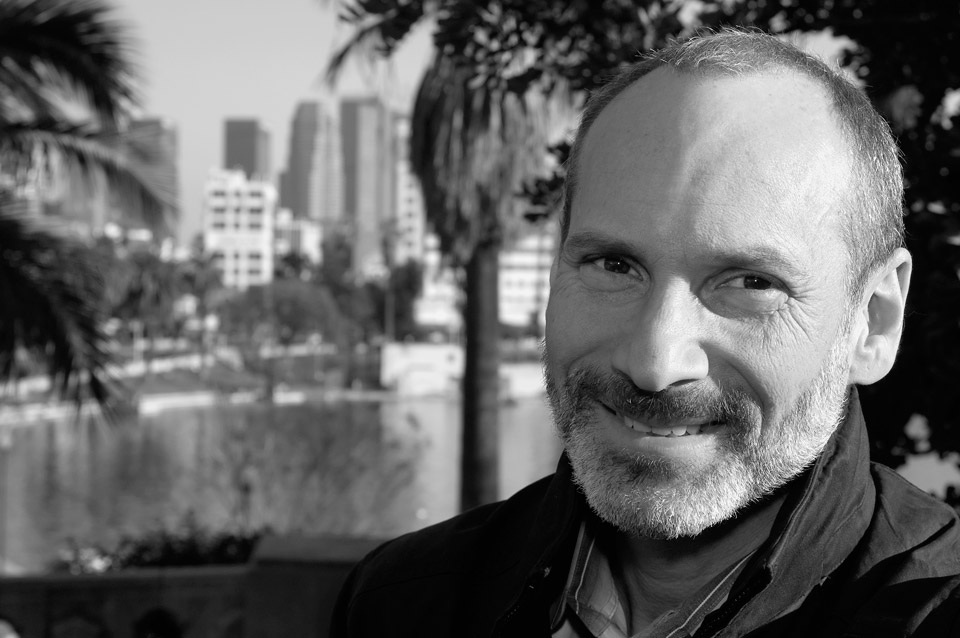
Aaron Paley is the President of Community Arts Resources (CARS), which produces festivals and concerts and provides expertise on the role of arts and culture in urban settings. For his inquiry, he researched and explored the concept of public space—its form and use—and developed new, enduring projects for Los Angeles that encourage human interaction and civic life.
Fellowship Summary
The Problem:
My initial goal with my Stanton Fellowship was to research and explore the concept of public space in Los Angeles—its form and use—and to develop new, enduring projects that offer alternatives to the current palette of choices. As one of the most park-poor major cities in the United States, Los Angeles fails to provide its citizens a fair amount of democratic gathering spaces where the diverse populations of the city can congregate and celebrate their city together.
Project Methodology:
While I knew early on that my end goal was to pick a pilot project that would demonstrate the goals of community engagement, transformation of space, and sustainable ephemera, my first step entailed casting a wide net of research surrounding the concept of public space. Part of my research plan included attending national conferences on urban planning and development in the hope of building a stronger understanding of how large-scale projects actually take hold.
In April of 2008, while at the American Planning Association’s National Planning Conference, I had an epiphany. I had attended a presentation on the Atlanta Beltline, a 22-mile greenspace combining trails, transit, and new development that would encircle the urban core of Atlanta. I was shocked at how revolutionary this would be for a big city: to have a public space that essentially connected the entire urban landscape and offered its citizens a democratic space for all to enjoy. And then it hit me: the Los Angeles River. Los Angeles is just as fortunate as Atlanta, as the LA River stretches for 52 miles through the second-largest city in the country.
When I returned home from the conference, I felt invigorated and eager to begin work on a Los Angeles River Festival—a celebratory event that would unite Angelenos around the historical importance and future potential of the LA River while highlighting the positive distinctions of our global city. I went so far as to develop a detailed proposal for such an event and to seek out sponsorship, as well as the political and community support needed to carry out a festival on this scale. Still, as I researched best practices for such a festival, I could not find a model for a river festival anywhere in the world that had relevance or resonance for our dear channelized and concretized Los Angeles River. As I searched for possible models, I asked many people along the way: a dry-river festival? A linear festival? Anything urban that stretched on for miles? Finally, Jason Neville, an urban planner for the Los Angeles CRA, asked if I knew about Bogotá’s ciclovía. I had to ask him to repeat it twice and then write it down. From that point forward, my Stanton track took an abrupt turn—one inspired by the simple concept of opening streets to the people who own them, activating existing public space in a new and revolutionary way.
I researched ciclovía and wrote an open letter to the mayor urging him to adopt the concept (this request appeared in the May 2009 issue of Los Angeles Magazine). The article drew the attention of an existing committee in Los Angeles working toward the implementation of an LA-specific ciclovía—CicLAvia. With the mission of mimicking Bogotá’s successes here in Los Angeles, I soon joined forces with this group of young advocates to brainstorm and offer my expertise on dealing with city processes and organizing public events.
In August of 2009, I visited the city that had spawned the original concept. Ciclovía, or “bicycle way” in Spanish, began in Bogotá in 1974. Today, over 70 miles of city streets are closed to motor vehicles every Sunday and opened for families, cyclists, joggers, skateboarders, and walkers. Nearly a third of the city’s resident population participates in the weekly event. My time in Bogotá was invaluable. I was so fortunate to meet and spend significant time with the founder of ciclovía, Jaime Ortíz. Jaime spoke to me about the need for an iconic and symbolic beginning, the importance of community participation and engagement, and the need to make ciclovía something that citizens adopt for themselves. I was also fortunate enough to meet with the current director of Bogotá’s ciclovía, the director of their innovative BRT system (TransMilenio), and the director of their workshop for Espacio Público, or “public space,” within the city’s Planning Department.
Starting in the fall of 2009, the CicLAvia steering committee began meeting with the City of Los Angeles Mayor’s Office and the LADOT to work through the details of the program. Thus far, the committee has received official support from Mayor Antonio Villaraigosa, City Council President Eric Garcetti, and Councilman José Huizar. A plethora of Neighborhood Councils have also lent their official support to the project. In addition, the committee has received numerous letters of support from the local bicycling community, including retail shops and advocacy groups. The Los Angeles County Bicycle Coalition (LACBC) has agreed to act as the fiscal receiver for the committee, while CicLAvia awaits official nonprofit status.
It has been invaluable for me to join forces with this diverse, grassroots group that brings a wide range of interests and ideas to the table for the purpose of advancing CicLAvia here in Los Angeles. I never imagined working this way. Yet, in retrospect, I do not see how it is possible to create such a broad-based program for the city without this kind of widespread citizen support.
Pending Next Steps:
The inaugural CicLAvia event is scheduled for Sunday, September 12, 2010. In 2011, the committee’s goal is to hold five events and expand the route to neighboring cities. The CicLAvia pilot route stretches from 1st Street & Soto light rail station in Boyle Heights to the Bicycle Kitchen in East Hollywood. Approximately 7.5 miles of city streets will be closed to motorized traffic; however, under the direction of the city’s Department of Transportation, key crossing points along the route will allow for cross traffic. The streets will be open to pedestrians and cyclists from 10:00 am to 3:00 pm, during which time artists, musicians, and community members will take part in events at designated nodes along the route. The ad hoc activities will create a more lively and vibrant public space, encouraging more people to take advantage of the temporary road closures.
While the CicLAvia steering committee is awaiting final confirmation from LADOT regarding the route, we are confident that the pilot event will take place on September 12 of this year. Having recently been honored with a $25,000 sponsorship grant from The California Endowment for the inaugural event, the steering committee looks forward to continuing its fundraising efforts to meet the goal of raising $100,000.