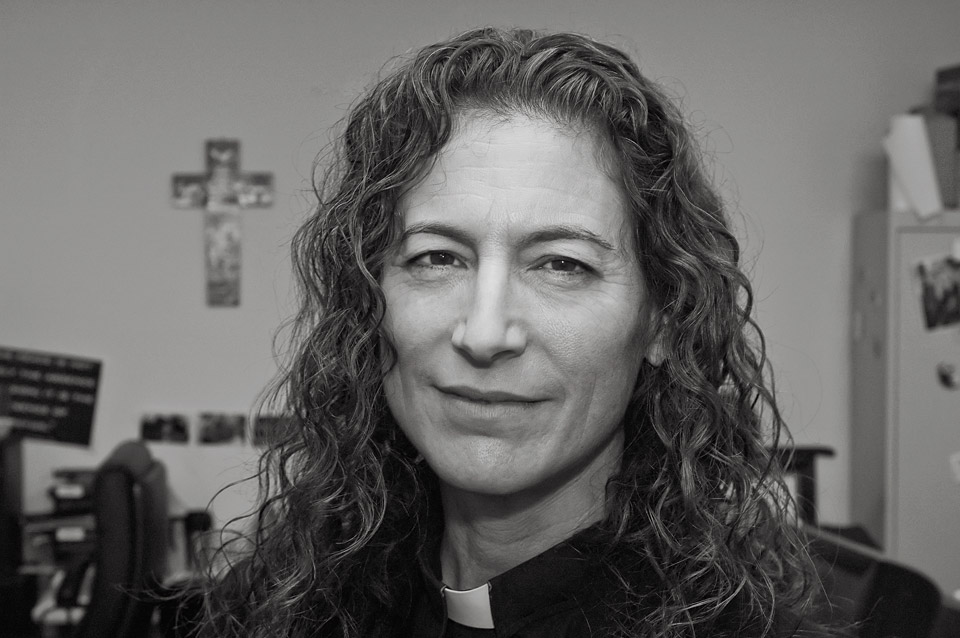
Alexia Salvatierra is the former Executive Director of Clergy and Laity United for Economic Justice (CLUE Justice), where she organized religious leaders and congregations to join low-wage workers in their struggle for economic justice and human rights. For her inquiry, she researched faith-rooted organizing models, and created an integrated model for the 21st century. She then worked with young religious activists to test and refine this model to address economic inequities in California, and disseminated their methods nationally.
* Alexia transitioned out of her role at CLUE Justice in 2011.
Fellowship Summary
From the Civil Rights Movement to the Moral Majority, religious leaders can have a major impact on public policy, popular culture, and the perceptions and values that form our decisions and shape our lives. However, the major community organizing models, which focus on the art and science of bringing people together to create change, have little to nothing to do with religion. Even traditional “faith-based” organizing sees the religious community primarily as a constituency, a vehicle for reaching a captive audience.
Yet, many of the organizing initiatives that have had the greatest impact on our society—from the labor initiatives of the early 1900s to the Civil Rights Movement and the Central American Sanctuary Movement—have had religious roots. Is this an accident of history, or are there rich resources in spirituality and spiritual traditions that can inform and strengthen community organizing?
When I first applied for the Stanton Fellowship, my organization had been experimenting for several years with the development of a “faith-rooted” organizing model. We had started to let religious visions, values, practices, community-building, texts, and symbols inform and impact all aspects of our organizing—and to bring all of this as a contribution to Los Angeles, California’s nationally acknowledged faith-community-labor coalition for economic justice. However, I didn’t have time to systematically develop the model.
The Stanton Fellowship enabled me to:
- Do an in-depth study of the core movements that utilize faith-rooted organizing models, seeking to identify commonalities and differences. I read texts that touched on the subject but, more importantly, I was also able to interview 16 veteran religious activists of the 20th century to find out how they saw the connections between their faith and their organizing in the context of their movements.
- Through that process, and in collaboration with our organizers around the state, I was able to write a draft concept paper and training curriculum by September of 2008. We then spent the next year experimenting with the curriculum in our different CLUE chapters. These “laboratories” included an intensive seven-month training for a group of 20 African American and Hispanic congregational leaders in South Los Angeles. These leaders not only became faith-rooted congregational and community organizers but who also learned to work together in the process. We taught a course on faith-rooted organizing at Vanguard University (a conservative evangelical college in Orange County). We also used the summer organizing project for youth leaders at CLUE LA as a laboratory for testing and refining the model.
- By Fall of 2009, we started working on a new training website, integrating all that we have learned from our laboratory training. We also started to give workshops around the country. This coming June, we will do our first national training in DC for faith and justice networks, as well as organizations from a number of states. The training will begin with a weekend workshop and then continue through monthly cyberspace “classes.” This schedule will force us to complete our interactive website (which has been organizationally very difficult to finish). I have also been asked by InterVarsity Press to write a book on faith-rooted organizing, which has likewise been difficult to find time to complete.
The Stanton Fellowship has allowed me to bring a new organizing model to fruition—a critically important contribution to organizing for the 21st century.