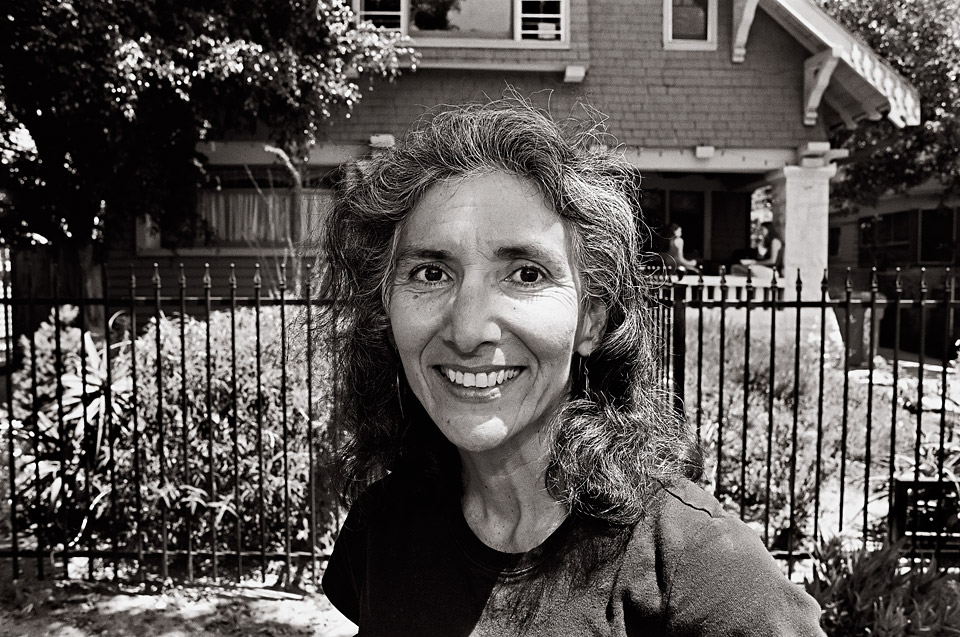
Gilda Haas is the former Executive Director of Strategic Actions for a Just Economy (SAJE). Her project goal was to shift the debate around how to address economic inequality, which she accomplished by creating popular education materials that used Web 2.0 tools to explain and engage people in understanding the root economic causes of current urban problems—such as the housing crisis, finance, employment, and land use—so they could make informed decisions about solutions.
* Gilda transitioned out of her role at SAJE in 2009.
Fellowship Summary
The Problem
How did Los Angeles acquire its present and dubious distinction as the most unequal city in the country? Meaning, the gap between its richest and poorest residents is wider than any other place.
If we do not understand the root economic causes of these problems and the human decisions that created them, then our solutions will always miss the mark and our vision of what is possible will be shortsighted. And if you believe, as I do, that solutions and social change come from the engaged and informed organization of those most impacted by these problems, then the key to solving LA’s current crisis of displacement, evictions, and dispossession lies in the capacity of grassroots people to analyze causes and imagine solutions.
What I said in my proposal
My proposal for the Stanton Fellowship was to build new popular economic education tools that will help organizers, their constituents, and thoughtful people throughout Los Angeles to better understand the forces that have increased inequality in Los Angeles and the country. These tools would provide examples from the field of how others have organized to take their cities back.
An additional goal was to make those materials available online, taking advantage of technology and adapting old-school techniques to new media.
What I Actually Did
Two things happened in the world that affected my project but not my purpose:
- I was diagnosed with cancer (no worries, I am fine now).
- The world was diagnosed with a chronic economic meltdown (worry, people, worry).
The first event influenced my decision to leave my position as the founding Executive Director of SAJE and reposition myself within the movement for economic justice.
A bumpy transition process ensued, culminating in a stronger Board and a fantastic new Executive Director, Paulina Gonzalez, who will undoubtedly take the organization in new and exciting directions.
The second event, the worldwide economic meltdown, elevated my original purpose into the here and now. The phone rang. A lot. Members of Just Economics, a women’s popular economics collective of which I had been a founding member, proposed that we reconnoiter to explain the meltdown. We did. The result was a “live illustration” called MELTDOWN that has been presented around the country to groups ranging in number from ten to 200.
My role was to turn the one-plus hour live workshop into digital material that could be shared online and to simulate some of the interaction, coaching, and confidence-building exercises that Just Economics brought to our in-person workshops. You can check out the results here, on the Dr. Pop website.
This work paralleled the business planning process that I had initiated for my overall project, which had a two-fold goal:
- Creating a website that could serve as a portfolio and discussion space.
- Establishing a coaching practice to help other people produce their own popular education, improve their facilitation and decision-making processes, and increase their confidence and understanding of issues related to the economy, urban planning, and democracy.
By the end of the process, I had become Dr. Pop.

How I Learned
I learned in the manner that reflects and enhances the way I teach:
- I hired the coaching team of Allen Gunn (Gunner) and David Taylor, who are experts in using technology for social change. They coached me through the business plan by providing me with great questions, techniques, and feedback. Gunner continues to provide me guidance.
- As part of the above process, I interviewed people who were representatives of my potential audience. I learned a lot from them.
- I hired Tiny Team, who designed the above logo and the website, while I figured out new ways to work with WordPress. I can now manage the site myself.
- I experimented with different kinds of software and equipment. I made a lot of mistakes, and I learned from those mistakes.
What Happens Next
Dr. Pop now consists of a five-member blogging team, each with their own beats, and continues to produce and post popular education tools:
- Myself (Do-It-Together)
- Gary Phillips, mystery writer, blogger for the FourStory website (he is also my husband – Popology)
- Celine Kuklowsky who lives in London, works for the Centre for Analysis of Social Exclusion at the London School of Economics, and Truthdig writer. (Really Important Things)
- Andrea Gibbons, also living in London and editor for PM Press. (London Eye)
- Ryan Hollon, a writer, educator, and synthesizer who lives in Chicago and works for the Center for Urban Economic Development at the University of Illinois. (World City Beat)
I also started a coaching and consulting practice beginning with the following clients:
Finally, I am working with Rosten Woo on an interactive online game (working title: The Zoning Game) to explain urban planning to the public (working title: The Zoning Game).
Dr. Pop now consists of a five-member blogging team, each member with their own beat, and continues to produce and post popular education tools:
I write the “Do-It-Together” beat.
- Gary Phillips — mystery writer, FourStory blogger, and my husband — writes the “Popology” beat.
- Celine Kuklowsky, who lives in London, works for the Centre for Analysis of Social Exclusion at the London School of Economics and writes for Truthdig. She authors the “Really Important Things” beat.
- Andrea Gibbons, who also lives in London, is an editor for PM Press. She writes the “London Eye” beat.
- Ryan Hollon, a writer, educator, and synthesizer based in Chicago, works for the Center for Urban Economic Development at the University of Illinois. He contributes the “World City Beat.”
I also launched a coaching and consulting practice, with my first clients including:
- Right to the City Alliance
- Black Workers Center
- LACAN
- Esperanza Community Housing Corporation
Finally, I am working with Rosten Woo on an interactive online game (working title: The Zoning Game) designed to explain urban planning to the public.
* The game has since launched under the title Blocks and Lots.